

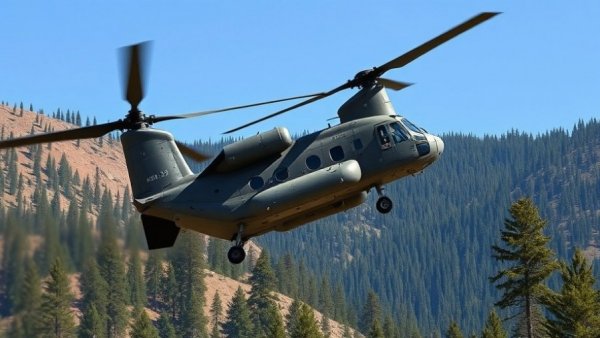
A Remarkable Recovery: CH-53K King Stallion in Action
In late September 2026, a significant operation unfolded in the Sierra Nevada mountains, showcasing the incredible capabilities of the CH-53K King Stallion helicopter. Dubbed one of the most powerful helicopters in the U.S. military's arsenal, the CH-53K was tasked with recovering a downed MH-60S Seahawk helicopter, which had encountered a tough landing at an elevation of 10,000 feet due to challenging terrain.
The operation was executed flawlessly by the Marine Operational Test and Evaluation Squadron (VMX) 1, demonstrating the advanced engineering and teamwork that goes into such critical missions. Major Lee Henderson, the pilot and planner for the operation, emphasized the importance of safety and care to maintain the integrity of the MH-60S throughout the process. "The hardest part of this recovery wasn’t necessarily lifting the H-60; it was figuring out how to do it safely without causing any additional damage,” Henderson noted.
The Role of Advanced Technology in Military Operations
The recovery highlighted the significant role that modern technology plays in military aviation. Utilizing a 70-foot long-line rigging system—a specialized configuration from the Naval Air Warfare Center Aircraft Division—allowed the team to lift the heavy helicopter effectively. By avoiding the main rotor head for lifting, experts ensured that the MH-60S remained mostly intact, which is critical for operational readiness. Engineer Michele Hoefer explained, "We wanted to maintain full structural integrity.”
Navigating Challenges in Harsh Environments
Recovering the MH-60S was no small feat, particularly given the steep elevation and remote location, which complicated logistics. The altitude and terrain meant that traditional methods, such as defueling the helicopter to reduce its weight, were not feasible. Fortunately, the CH-53K's robust power capabilities positioned it as the only potential lifter for the task, drastically averting any risk of loss or further damage to the downed Seahawk.
Brandon Norris, who led the rigging team, emphasized the effective teamwork that made the operation possible. With detailed testing and coordination involving the H-60 Fleet Support Team based at Marine Corps Air Station, they executed safety tests at Naval Air Station Patuxent River, Maryland.
Celebrating Teamwork and Innovation
The recovery operation reflects broader themes of collaboration, innovation, and commitment in the military. By integrating the knowledge from various divisions and leveraging existing infrastructures, such as locally available tools, the operation not only proved successful but also highlighted a commitment to cost-effective solutions—a testament to the military’s adaptability in the face of challenges.
This event encapsulates the spirit of the Marine Corps and its continuous pursuit of excellence, inviting us all to recognize the extraordinary efforts of those who work tirelessly to ensure missions are accomplished safely and efficiently. As technology progresses, the stories of these innovative military operations not only highlight the advancements in machinery but remind us of the dedicated individuals behind them.

Write A Comment